

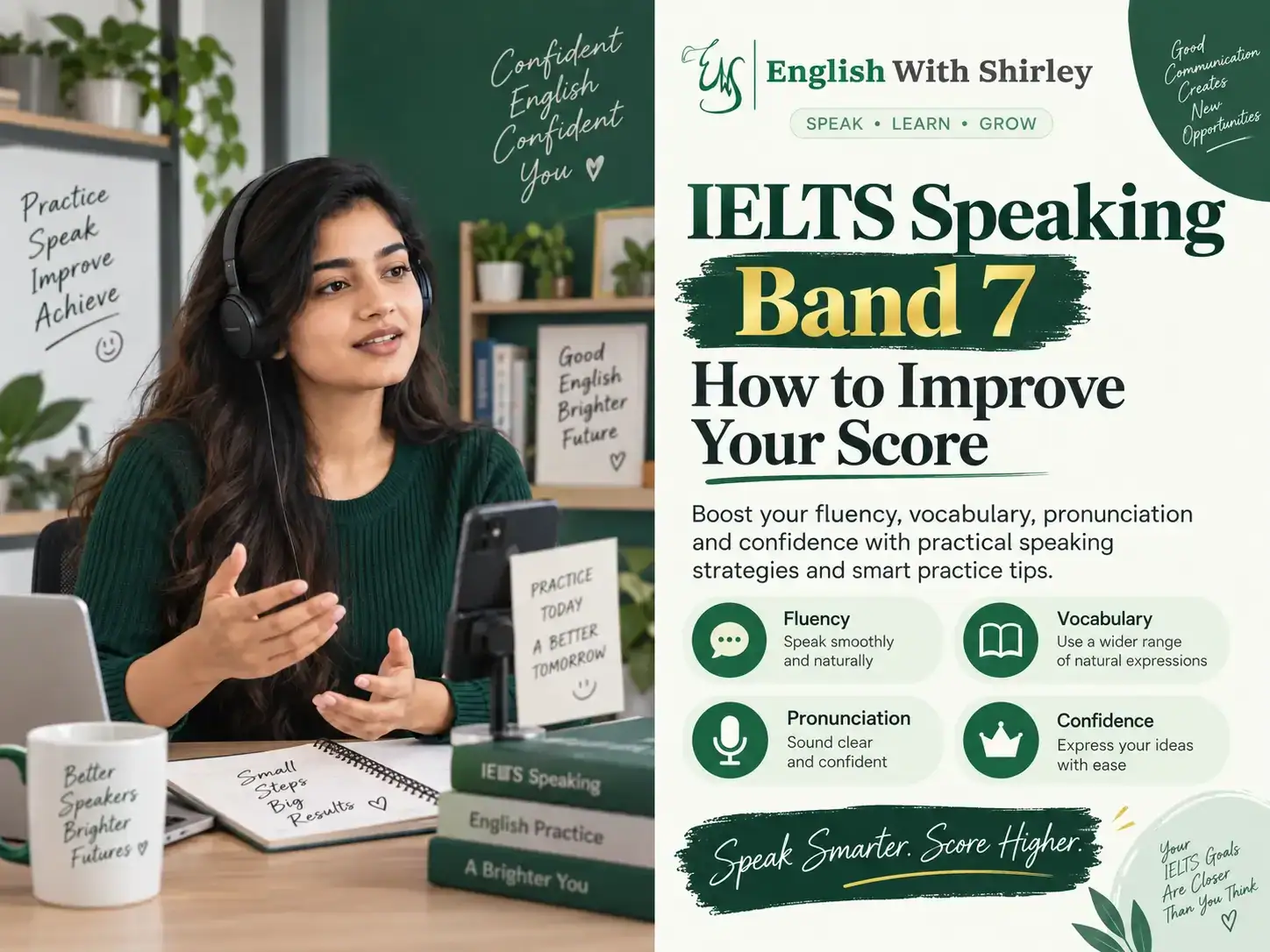
IELTS Speaking Band 7: How to Improve Your Score
Achieving Band 7 in IELTS Speaking is not simply about speaking fast or using complicated English. A strong score requires clear communication, flexible vocabulary, accurate grammar, good pronunciation, and the ability to develop your answers naturally. The IELTS Speaking test assesses these skills across four equally weighted criteria.
If you are preparing for IELTS and want to improve your speaking performance, the most effective approach is to identify your weakest area and practise it consistently. Along with IELTS preparation, regular speaking practice can help you become more fluent, confident, and accurate.
What Does IELTS Speaking Band 7 Require?
Your IELTS Speaking score is based on four criteria: fluency and coherence, lexical resource, grammatical range and accuracy, and pronunciation. Each criterion contributes equally to your final speaking score.
This means that improving only your vocabulary or pronunciation may not be enough. For example, if your vocabulary and pronunciation are strong but your grammar is consistently weak, your overall performance can still be affected.
A useful strategy is to evaluate each area and spend more time improving the skill that needs the most attention.
1. Improve Fluency and Coherence
Fluency does not mean speaking as quickly as possible. For IELTS Speaking Band 7, you should be able to speak at length without frequent hesitation while keeping your ideas organised.
Avoid relying heavily on fillers such as “um”, “like”, and “you know”. Instead of filling every pause, take a short moment to think and continue your answer naturally.
Coherence is equally important. Connect your ideas using expressions such as “as a result”, “having said that”, “what really made a difference was”, and “the thing that surprised me was”. Try to vary your linking expressions instead of repeatedly using the same word.
2. Build a Stronger Vocabulary
Using the same basic adjectives repeatedly can limit your ability to demonstrate vocabulary range. Words such as “good”, “bad”, “nice”, “big”, and “interesting” are useful, but you should learn more precise alternatives.
For example, instead of saying “a good solution”, you could say “an effective approach” or “a practical measure”. Instead of saying “very tired”, you could use words such as “exhausted” or “drained”, when appropriate.
However, do not use difficult words simply to sound advanced. The goal is to choose accurate vocabulary and use common word combinations naturally. Developing your overall English vocabulary and writing skills can also support your communication development.
3. Improve Grammar Range and Accuracy
Grammar is another important part of IELTS Speaking. Band 7 performance requires a mixture of simple and complex sentence structures with generally good accuracy.
Instead of using the same sentence structure throughout your answer, practise conditionals, relative clauses, different tenses, and longer sentences.
For example:
- If I had more time, I would travel more frequently.
- The place where I grew up has changed considerably.
- Although technology makes life easier, it can also create new challenges.
You do not need perfect grammar in every sentence. Occasional mistakes can occur. What matters is demonstrating range while maintaining overall control. A strong foundation in English grammar can help you speak more accurately and confidently.
4. Focus on Clear Pronunciation
You do not need to copy a British or American accent to achieve a high IELTS Speaking score. The priority should be clear and understandable pronunciation.
Work on individual sounds, word stress, sentence stress, and natural intonation. Avoid speaking so quickly that your words become difficult to understand.
Practising short conversations aloud and recording yourself can help you notice unclear words, rushed sentences, and unnatural pauses.
Understand the Three Parts of IELTS Speaking
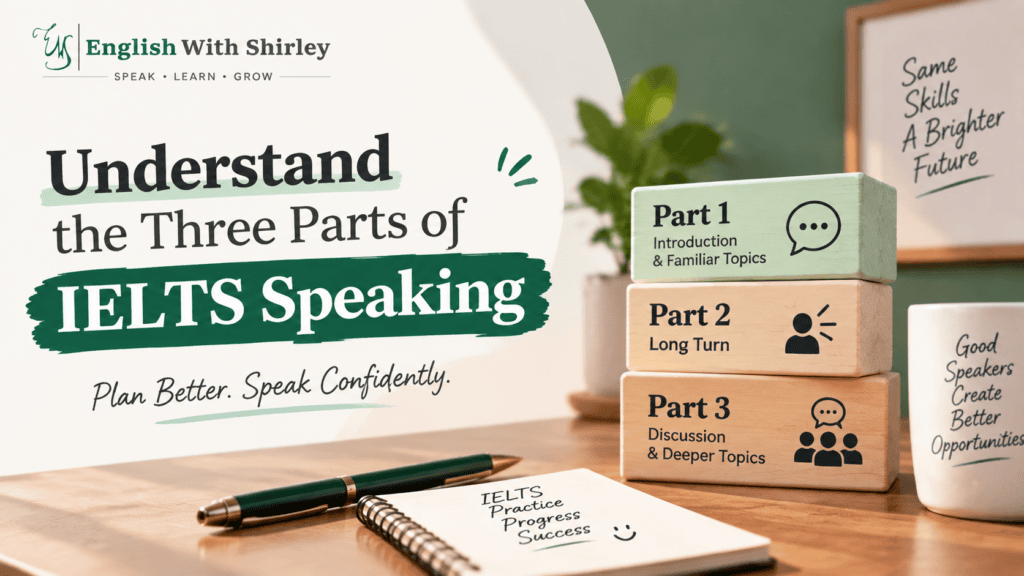
Part 1: Personal and Familiar Questions
Part 1 includes questions about familiar subjects. Avoid answering with only one or two words. Give your answer, add a reason, and provide a short example when possible.
For example, instead of saying “Yes, I like reading”, develop your response by explaining what you read and why you enjoy it.
Part 2: The Long Turn
Part 2 requires you to speak about a given topic for an extended period. Use your preparation minute wisely. Write down a few keywords, ideas, examples, and transition phrases.
Try to continue speaking logically rather than stopping after a short answer. Organise your response with a beginning, supporting details, examples, and a conclusion.
Part 3: Discussion
Part 3 involves more abstract questions and gives you an opportunity to demonstrate your ability to express and explain opinions.
Give a clear opinion, explain why you think that way, provide an example, and consider another perspective when appropriate. This is a good opportunity to demonstrate complex grammar and a wider vocabulary range.
Common IELTS Speaking Mistakes to Avoid
- Memorising complete answers and repeating them mechanically.
- Giving very short answers without developing your ideas.
- Speaking too quickly in an attempt to sound fluent.
- Repeating the exact wording of the examiner’s question.
- Using the same vocabulary and linking expressions repeatedly.
- Practising without receiving useful feedback.
Memorising useful vocabulary and ideas for common topics can be helpful, but avoid memorising complete scripts. Your answers should sound natural and reflect your own ideas.
Useful Phrases for IELTS Speaking
You can practise natural expressions that help you organise your thoughts and extend your answers. Some useful examples include:
- To be honest, I hadn’t really thought about it until now, but…
- The thing that stands out for me is…
- I suppose you could argue both ways, though on balance…
- What really made a difference was…
- It’s not something I’m particularly keen on, mainly because…
Use these expressions naturally. Avoid forcing too many prepared phrases into one answer.
Create a Consistent IELTS Speaking Practice Routine
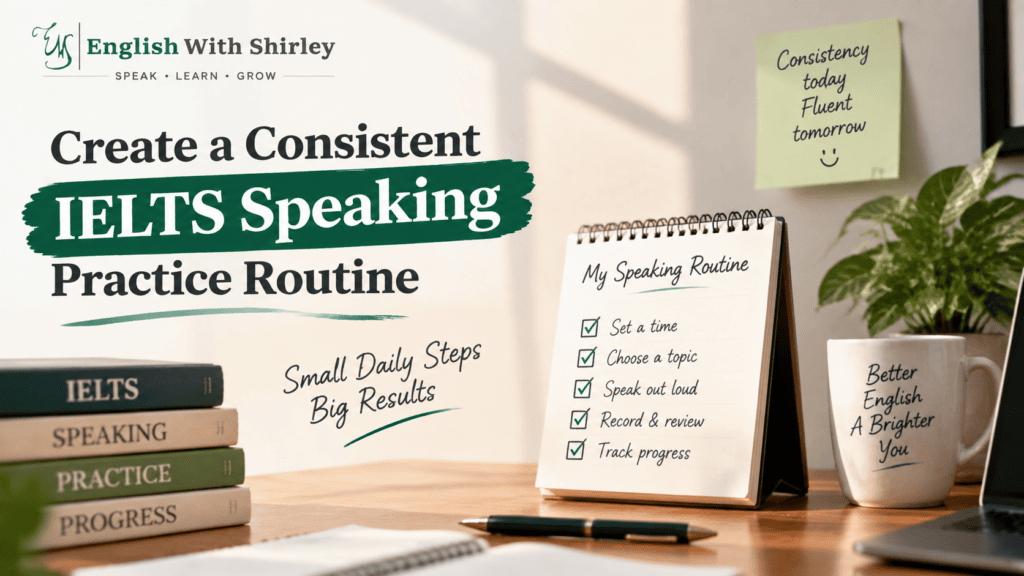
Regular practice is one of the best ways to improve speaking performance. Instead of spending an hour speaking without a clear goal, record yourself answering an IELTS Part 2 topic for two minutes.
After recording, review your answer and check:
- How often did you use filler words?
- Did you use different linking expressions?
- Did you repeat the same vocabulary?
- Were any sentences rushed or unclear?
- Did you use a mixture of simple and complex sentences?
Practise different topics such as work, education, technology, travel, hobbies, and your hometown. If you are looking for structured English courses, guided learning can help you practise consistently and receive support where you need it most.
How to Improve Your IELTS Speaking in Four Weeks
A simple four-week practice plan can make your preparation more organised.
- Week 1: Focus on fluency, pronunciation, and reducing unnecessary pauses.
- Week 2: Build topic-specific vocabulary and practise useful collocations.
- Week 3: Practise complex grammar structures and develop longer answers.
- Week 4: Complete timed speaking practice and review your weakest areas.
For additional support, consistent professional spoken English practice can also help you become more comfortable expressing ideas clearly in English.
Frequently Asked Questions
Is IELTS Speaking Band 7 difficult to achieve?
Band 7 requires consistent performance across fluency, vocabulary, grammar, and pronunciation. With focused practice and useful feedback, learners can gradually improve their performance.
Does my accent affect my IELTS Speaking score?
You do not need a particular accent. The important factor is that your pronunciation is clear and understandable. Work on sounds, word stress, and intonation rather than trying to completely change your natural accent.
How long should I speak in IELTS Speaking Part 2?
You should aim to use the available speaking time effectively. Use the preparation minute to organise your ideas and then develop your answer with explanations and examples rather than stopping after a short response.
Should I memorise IELTS Speaking answers?
Memorising complete answers is generally not a good strategy. Prepare useful vocabulary, ideas, and expressions instead, but adapt them naturally to the question you receive.
Can grammar mistakes prevent me from getting Band 7?
Occasional mistakes do not automatically prevent a Band 7 score. You should demonstrate a range of grammatical structures while maintaining generally good accuracy and clear communication.
Final Thoughts

Improving your IELTS Speaking score requires more than learning difficult vocabulary. You need to develop fluency, coherence, vocabulary, grammar, and pronunciation together. Identify your weakest area, practise it regularly, record your speaking, and review your performance.
With consistent preparation and the right learning support, you can become more confident in expressing your ideas and work towards your target IELTS Speaking score. Explore IELTS preparation at English with Shirley to continue developing your English communication and speaking skills.