Category: English Course

Online English Speaking Course for Better Fluency and Confidence

Online English Speaking Course for Better Fluency and Confidence

English has become an important part of education, careers, business and everyday communication. Whether you are preparing for an interview, studying for an examination, communicating at work or simply trying to speak English more confidently, regular speaking practice can make a meaningful difference.

An online English speaking course can provide a structured way to improve your speaking, vocabulary, grammar, pronunciation and overall communication skills. Instead of learning English only through books or memorising grammar rules, online learning can give you opportunities to practise using English in practical situations.

English With Shirley offers English learning programs for different goals, including spoken English, grammar, writing, IELTS preparation and professional communication. You can explore the English courses at English With Shirley to understand the available learning options.

What Is an Online English Speaking Course?

An online English speaking course is a structured learning program that helps learners develop their ability to communicate in English through online lessons and regular practice.

Depending on the course and learner’s level, lessons may include conversation practice, vocabulary development, grammar, pronunciation, listening activities, sentence formation and real-life communication exercises.

The purpose is not simply to learn English rules. The goal is to help learners use English more naturally and confidently in situations that matter to them.

Why Choose an Online English Speaking Course?

Online English learning can be useful for learners who want flexibility along with structured guidance. You can attend lessons from your home or another suitable location without spending time travelling to a classroom.

A well-planned online English speaking course can help you:

  • Practise speaking English regularly
  • Improve fluency and sentence formation
  • Build useful vocabulary
  • Strengthen grammar
  • Work on pronunciation
  • Improve listening skills
  • Develop communication confidence
  • Use English in practical situations

However, attending online classes is only one part of learning. Consistent practice outside the class is equally important for building stronger English communication skills.

Who Can Join Online English Speaking Classes?

Online English speaking classes can be useful for learners with different backgrounds and learning objectives.

Students

Students may want to improve their English for presentations, academic communication, interviews, higher education or English proficiency examinations.

Regular speaking and writing practice can help students express their ideas more clearly and become more comfortable communicating in English.

Beginners

Beginners may find it difficult to form sentences, remember vocabulary or speak without hesitation. A structured course can help them start with basic English and gradually move towards longer conversations.

English With Shirley also provides spoken English programs for kids and adults with learning focused on practical English communication.

Working Professionals

Professionals may need English for meetings, presentations, interviews, emails, client conversations and workplace discussions.

The Spoken English for Professionals program can be explored by learners who want to develop their English communication for professional situations.

IELTS Learners

Learners preparing for IELTS need to develop multiple English skills, including speaking, listening, reading and writing. Building stronger overall communication skills can support regular IELTS preparation.

If IELTS is your goal, you can explore the IELTS preparation program at English With Shirley.

What Do You Learn in an Online English Speaking Course?

A good English speaking program should not focus only on speaking. Grammar, vocabulary, listening and pronunciation all contribute to effective communication.

1. Everyday English Conversation

Conversation practice helps learners become more comfortable using English in everyday situations.

You can practise conversations related to introductions, family, education, work, shopping, travel, hobbies, daily routines and other common situations.

Regular conversation practice can help you form sentences more naturally instead of translating every thought from your first language.

2. English Vocabulary

Vocabulary gives you the words you need to express your ideas. However, learning hundreds of words without using them may not improve your speaking ability.

Instead, learn useful vocabulary in context. Choose a topic, learn relevant words and then use those words in your own sentences.

For example, when learning vocabulary related to work, practise words such as meeting, deadline, presentation, responsibility, project and feedback through complete sentences.

3. Grammar for Spoken English

Grammar helps you create clear and accurate sentences. Beginners should build a strong foundation in areas such as tenses, articles, prepositions, sentence structure and subject-verb agreement.

Grammar should not be treated as something that exists only in textbooks. Try to use grammar concepts while speaking and writing.

If you want to strengthen your foundation, explore the English Grammar Course for structured grammar learning.

4. Pronunciation Practice

Clear pronunciation makes spoken communication easier to understand. Learners can work on individual sounds, word stress, sentence rhythm and commonly mispronounced words.

Listening carefully to fluent English speakers and repeating useful phrases can also help you become more familiar with natural pronunciation patterns.

5. Listening Skills

Speaking and listening work together. When you improve your listening skills, you become more familiar with vocabulary, pronunciation, sentence structures and natural conversation patterns.

Try listening to English interviews, conversations, educational videos, presentations and other content regularly.

6. Sentence Formation

Many beginners know individual English words but struggle to combine them into complete sentences.

Sentence-building activities can help you move from individual words to meaningful communication. Start with simple sentences and gradually practise compound and more detailed sentences.

How Can an Online English Speaking Course Improve Confidence?

Confidence often develops through repeated practice. If you rarely speak English, it is natural to feel uncomfortable when you suddenly need to communicate in English.

Regular speaking activities give you more opportunities to practise. You can talk about familiar topics first and gradually move towards discussions, presentations, interviews and professional conversations.

Do not wait until your English is perfect before speaking. Making mistakes can help you identify what you need to improve.

The objective should be to communicate your ideas clearly while continuously working on grammar, vocabulary, pronunciation and fluency.

Online English Speaking Classes for Beginners

Beginners often need a different learning approach from advanced English speakers. Instead of starting with complicated vocabulary or difficult conversations, it is useful to build a strong foundation.

Beginner English speaking practice can include:

  • Introducing yourself
  • Talking about your family
  • Describing your daily routine
  • Talking about hobbies
  • Asking and answering simple questions
  • Learning everyday vocabulary
  • Building basic sentences
  • Practising common conversations

Once these basic skills become more comfortable, learners can gradually move towards longer conversations and more advanced communication.

Online English Speaking Course for Professionals

Professional communication requires more than everyday English. Professionals may need to communicate clearly during meetings, interviews, presentations, calls and client discussions.

An online English speaking course can help professionals practise situations that are relevant to their workplace.

Useful areas of professional English practice include:

  • Introducing yourself professionally
  • Participating in meetings
  • Giving presentations
  • Answering interview questions
  • Speaking with clients
  • Explaining ideas clearly
  • Asking professional questions
  • Handling workplace conversations

For broader workplace communication, explore Business and Corporate English at English With Shirley.

How to Practise English Speaking Every Day

You do not need several hours every day to practise English. A consistent routine of short activities can be easier to maintain.

Speak for 10 Minutes

Choose a familiar topic and speak about it for ten minutes. You can describe your day, explain a recent experience or talk about something you enjoy.

Learn Five Useful Words

Choose five useful words or phrases every day. Create your own sentences using each one.

Listen to English

Spend some time listening to English conversations, interviews or educational videos. Pay attention to pronunciation and sentence patterns.

Read Out Loud

Reading aloud can help you become more comfortable pronouncing English words and sentences. It can also help you notice sentence rhythm and pauses.

Record Your Voice

Recording yourself speaking can help you notice repeated words, pauses and pronunciation issues. You can compare your progress over time.

How to Improve English Fluency Online

Fluency does not mean using complicated vocabulary in every sentence. It means being able to communicate your thoughts with reasonable ease and clarity.

To work on fluency, focus on regular communication rather than memorising long lists of words.

Try these activities:

  1. Think about a topic in English.
  2. Speak without stopping to translate every sentence.
  3. Use simple words when you do not know a difficult word.
  4. Practise connecting ideas with words such as because, however, therefore and although.
  5. Repeat conversations until they feel more natural.
  6. Review your mistakes and practise the corrected sentences.

Over time, regular practice can help you become more comfortable expressing yourself in English.

Online English Learning for IELTS Preparation

English speaking skills are particularly important for learners preparing for IELTS. The speaking test requires you to communicate your ideas clearly and respond to questions in English.

However, IELTS preparation involves more than speaking. Learners should also practise listening, reading and writing while developing grammar and vocabulary.

For dedicated preparation, visit the IELTS course page and explore the available learning options.

Improve English Writing Alongside Speaking

Speaking and writing are different skills, but both require vocabulary, grammar and organised ideas.

Writing practice can help you understand sentence structure and identify grammar mistakes that may also appear in your spoken English.

You can practise writing short paragraphs, emails, descriptions, summaries and opinions. For focused writing development, visit the English With Shirley Writing Skills program.

English Learning Beyond Regular Classes

Classes provide structure and guidance, but learners can continue practising English outside their lessons.

Use English during your daily routine whenever possible. Change the language of your learning resources to English, read English articles, listen to English content and try to communicate in English with people around you.

You can also explore the English With Shirley blog for additional English learning topics and resources.

How to Choose the Right Online English Speaking Course

Before joining an online English speaking course, consider your current level and learning objective.

A suitable course should ideally provide:

  • Structured lessons
  • Regular speaking practice
  • Grammar guidance
  • Vocabulary development
  • Pronunciation support
  • Listening activities
  • Practical communication exercises
  • Feedback and guidance

You can learn more about English With Shirley’s teaching approach on the Why Choose Us page.

English Speaking Practice for Different Learning Goals

One advantage of structured English learning is that you can focus your practice according to your objective.

For Everyday Communication

Practise conversations about family, friends, shopping, travel, hobbies, routines and common daily situations.

For Academic Goals

Focus on vocabulary, presentations, writing, discussions, reading and listening skills that support academic communication.

For Career Development

Practise interviews, presentations, meetings, professional vocabulary, workplace conversations and client communication.

For English Proficiency Exams

Build your speaking, listening, reading and writing skills while becoming familiar with the requirements of your target examination.

Common Mistakes English Learners Should Avoid

Learning English becomes more effective when you avoid habits that limit your practice.

  • Studying grammar without speaking
  • Memorising vocabulary without using it
  • Being afraid of making mistakes
  • Practising only before an examination
  • Ignoring pronunciation
  • Using very complicated words unnecessarily
  • Translating every sentence before speaking
  • Studying irregularly

Instead, focus on practical English use and consistent improvement.

Frequently Asked Questions

What is an online English speaking course?

An online English speaking course is a structured program that helps learners improve spoken English through online lessons, speaking activities, vocabulary, grammar, pronunciation and practical communication practice.

Are online English speaking classes suitable for beginners?

Yes. Beginners can start with basic vocabulary, grammar, sentence formation and simple conversations before progressing to more advanced English communication.

Can I improve my English speaking skills online?

Yes. Regular online lessons combined with speaking practice, listening activities, vocabulary development and feedback can support improvement in English communication skills.

How can I practise English speaking at home?

You can speak about your daily routine, read aloud, listen to English content, record your voice, learn useful vocabulary and practise conversations regularly.

Can an online English speaking course help professionals?

Yes. Professionals can practise workplace conversations, interviews, meetings, presentations, client communication and other situations relevant to their work.

Can online English speaking classes help with IELTS?

They can support IELTS preparation by helping learners practise speaking and improve their broader English communication skills. IELTS preparation should also include listening, reading and writing practice.

How long does it take to improve English fluency?

The learning time varies depending on your starting level, goals, practice routine and consistency. Regular practice can gradually improve fluency, vocabulary, pronunciation and confidence.

Start Improving Your English Speaking Skills

Becoming comfortable in English takes regular practice. You do not need to know every English word or grammar rule before you start speaking. Begin with simple conversations, practise regularly and gradually increase the complexity of your communication.

An online English speaking course can provide structured learning while allowing you to practise English from a convenient location. With consistent speaking, listening, reading and writing practice, you can continue developing your communication skills over time.

If you are looking for structured English learning, explore the English With Shirley courses. You can also contact English With Shirley to discuss your learning requirements.

You can also learn more about Shirley and her teaching approach through the About Shirley page.

Online English Classes to Improve Your English Skills

Online English Classes to Improve Your English Skills

Online English Classes to Improve Your English Skills

Learning English is not only about memorising grammar rules or learning difficult vocabulary. To communicate confidently, you need regular practice in speaking, listening, reading and writing. For many learners, online English classes offer a flexible and structured way to develop these important skills from the comfort of home.

Whether you are a student, working professional, job seeker, business owner or beginner, online English learning can help you improve your communication habits. With guided lessons, practical activities and consistent practice, you can gradually become more comfortable using English in everyday and professional situations.

English With Shirley offers English learning programs covering spoken English, grammar, writing, IELTS preparation and professional communication. Explore the English courses at English With Shirley to understand which program may suit your learning goals.

Why Are Online English Classes Useful?

Why Are Online English Classes Useful?

Traditional classroom learning may not always fit everyone’s schedule. Travel time, fixed class timings and daily responsibilities can make regular attendance difficult. Online learning provides flexibility and allows learners to practise English according to their availability.

However, effective online English learning is not only about attending classes. Learners also need regular opportunities to speak, write, listen and apply what they learn.

Well-structured online English classes can help you:

  • Improve spoken English and fluency
  • Build a stronger English vocabulary
  • Strengthen grammar and sentence formation
  • Improve pronunciation
  • Develop listening and comprehension skills
  • Practise English conversations
  • Improve writing skills
  • Build confidence while communicating

Who Can Benefit From Online English Learning?

Online English learning can be useful for learners with different backgrounds, levels and objectives.

Students

Students may want to improve their English for academic assignments, presentations, interviews, examinations or higher education. Regular speaking and writing practice can help students express their ideas more clearly.

Working Professionals

Professionals often need English for meetings, presentations, emails, interviews, client communication and workplace conversations. The Spoken English for Professionals program can support learners who want to develop communication skills for professional situations.

Beginners

Beginners may face difficulties with basic grammar, vocabulary, sentence formation or hesitation. Starting with simple English lessons and gradually moving towards longer conversations can make the learning process more comfortable.

English With Shirley also provides spoken English learning for kids and adults, helping learners explore English according to their level and requirements.

What Can You Learn in Online English Classes?

What Can You Learn in Online English Classes?

A complete English learning program should cover more than speaking. Speaking, listening, reading, writing, grammar and vocabulary work together to improve overall communication.

1. Spoken English and Conversation Practice

Speaking practice helps learners become more comfortable expressing their thoughts in English. During regular practice, you can work on introductions, everyday conversations, questions and answers, discussions, presentations and professional communication.

Speaking regularly can also help reduce hesitation and make sentence formation more natural. You do not need to wait until your English is perfect before you start speaking. Mistakes can help you understand which areas require improvement.

2. Grammar and Sentence Formation

Grammar provides the foundation for clear and accurate communication. Learners should understand important concepts such as sentence structure, tenses, articles, prepositions, conjunctions and subject-verb agreement.

Grammar becomes more useful when you apply it in real conversations and writing activities. Instead of memorising rules alone, practise using each grammar concept in your own sentences.

If you want to strengthen your English grammar foundation, explore the English Grammar Course offered by English With Shirley.

3. Vocabulary Development

A strong vocabulary helps you express your thoughts more clearly and accurately. However, memorising random word lists may not be enough. It is better to learn new words in context and practise using them in everyday situations.

For example, you can learn vocabulary related to education, work, travel, technology, business, health or daily activities. After learning a new word, create your own sentences and use it while speaking or writing.

4. Listening Skills

Good communication also requires good listening skills. Listening to English conversations, interviews, educational videos and presentations can help you become familiar with different accents, pronunciation patterns and speaking styles.

While listening, try to identify the main idea first. Then focus on important details, commonly used expressions and the way speakers connect their ideas.

5. English Writing Skills

English communication is not limited to speaking. Students and professionals regularly need to write emails, messages, reports, applications, essays and other documents.

Writing practice can help you organise your thoughts and communicate information more effectively. It also allows you to identify common grammar, vocabulary and sentence-formation mistakes.

To improve your written English, explore the Writing Skills program for focused practice in sentence construction, paragraphs and different types of writing.

How Online English Classes Can Improve Speaking Confidence

How Online English Classes Can Improve Speaking Confidence

Many learners understand English but hesitate when they have to speak. This may happen because they do not get enough opportunities to practise or because they are afraid of making mistakes.

Regular speaking activities can gradually make English communication more comfortable. You can practise describing your daily routine, discussing a topic, answering questions, explaining an opinion or giving a short presentation.

Try to focus on communicating your message clearly instead of trying to make every sentence perfect. With regular practice and useful feedback, you can work on fluency, pronunciation, grammar and confidence.

Personalised English Learning for Different Goals

Every learner has different English requirements. A beginner may need basic grammar and everyday vocabulary, while a working professional may need help with meetings, presentations and workplace communication.

A suitable learning plan should match your current English level and personal objective.

  • Beginners: Focus on basic grammar, vocabulary, sentence formation and simple conversations.
  • Students: Focus on speaking, writing, vocabulary, grammar and academic communication.
  • Professionals: Focus on meetings, presentations, interviews and workplace English.
  • IELTS learners: Focus on speaking, listening, reading, writing, vocabulary and grammar.

If you want to improve workplace communication, you can also explore the Business and Corporate English program.

How to Get Better Results From Online English Classes

How to Get Better Results From Online English Classes

Joining an online English course is only one part of the learning process. Your practice outside the class also plays an important role in improving your English skills.

1. Attend Classes Regularly

Try to follow a consistent learning schedule. Regular attendance can help you understand new concepts, revise previous lessons and build better learning habits.

2. Speak English Every Day

Spend a few minutes speaking English every day. You can talk about your work, studies, hobbies, family, plans or daily activities.

3. Read English Content

Read English articles, books, educational materials and short stories. Reading can introduce you to useful vocabulary and natural sentence structures.

4. Listen to English Content

Listen to interviews, conversations, podcasts and educational videos. Pay attention to pronunciation, sentence patterns and commonly used expressions.

5. Use New Vocabulary

Whenever you learn a new word or phrase, use it in your own sentences. Active use makes vocabulary easier to remember.

6. Practise Writing

Write short paragraphs, emails, journal entries or summaries. Review your writing and identify repeated grammar or sentence-formation mistakes.

7. Ask for Feedback

Feedback can help you identify mistakes that you may not notice on your own. Guidance from a teacher can make your learning more focused and practical.

Online English Classes for Professional Communication

English is widely used in professional environments. Employees may need English for meetings, presentations, interviews, emails, client conversations and workplace discussions.

Professional communication requires more than knowing English words. You also need to understand how to express ideas clearly, ask questions politely, respond appropriately and communicate with different people.

Learners who want to improve their workplace communication can explore professional spoken English training at English With Shirley.

Online English Learning for IELTS Preparation

Many learners join English classes because they are preparing for an international English proficiency examination. IELTS preparation requires practice in speaking, listening, reading and writing.

Improving your overall English communication skills can support your exam preparation. Regular vocabulary, grammar, speaking and writing practice can help you become more comfortable with English tasks.

If IELTS is your goal, explore the IELTS preparation program at English With Shirley.

How to Choose the Right Online English Course

How to Choose the Right Online English Course

There are many English learning options available online. Before choosing a course, consider your current level, learning objective, preferred schedule and the skills you need to improve.

Look for an English learning program that provides:

  • A clear and structured curriculum
  • Practical speaking opportunities
  • Grammar and vocabulary support
  • Listening and pronunciation practice
  • Writing development
  • Relevant exercises and activities
  • Guidance and feedback
  • A learning plan suitable for your level

You can also learn more about the learning approach through the Why Choose Us page before selecting a suitable program.

Simple Daily English Practice Routine

You do not need to spend several hours every day practising English. A short but consistent routine can be easier to follow and maintain.

  1. Read an English article for 10 minutes.
  2. Learn five useful words or phrases.
  3. Speak in English for 10 minutes.
  4. Listen to an English conversation or video.
  5. Write five to ten sentences about your day.
  6. Review your common grammar mistakes.

As your confidence improves, gradually increase the difficulty of your speaking, reading and writing activities.

Common Mistakes English Learners Should Avoid

Many learners progress slowly because they focus on only one part of English. Try to avoid these common mistakes:

  • Studying grammar without speaking
  • Memorising vocabulary without using it
  • Being afraid of making mistakes
  • Practising only before an examination
  • Ignoring pronunciation
  • Avoiding writing practice
  • Studying irregularly
  • Translating every sentence before speaking

Instead, try to use English every day and focus on gradual improvement.

Frequently Asked Questions

Are online English classes suitable for beginners?

Yes. Beginners can start with basic grammar, vocabulary, sentence formation and simple conversations before progressing towards advanced English communication.

Can online English classes improve speaking skills?

Yes. Regular speaking practice can help learners become more comfortable expressing ideas, answering questions and participating in conversations.

How can I improve my English speaking at home?

Speak English every day, listen to English content, read regularly, learn useful vocabulary and practise forming sentences without translating every thought.

Are online English classes useful for professionals?

Yes. Professionals can use online English learning to practise meetings, presentations, interviews, workplace conversations, emails and client communication.

Can online English classes help with IELTS preparation?

Online English classes can support IELTS preparation when the learning program includes relevant speaking, listening, reading and writing practice.

How long does it take to improve English communication skills?

The time varies according to your current English level, learning goals, practice routine and consistency. Regular practice can gradually improve confidence, vocabulary, fluency and accuracy.

Start Improving Your English With Structured Learning

Start Improving Your English With Structured Learning

Improving English is a gradual process. You do not need to know every grammar rule or use complicated vocabulary to communicate effectively. Regular practice, useful feedback and real communication opportunities are important for steady progress.

Online English classes can provide a structured way to improve speaking, listening, reading, writing, grammar and vocabulary while fitting learning into your daily routine.

If you are ready to improve your English communication skills, explore the English With Shirley courses or contact English With Shirley to discuss your learning requirements.

ChatGPT Image Sep 17, 2026, 03_19_03 PM

Online English Classes for IELTS & TOEFL Preparation

Preparing for international English language exams such as IELTS and TOEFL requires more than memorising grammar rules or learning new vocabulary. You need to develop practical skills in speaking, listening, reading and writing while becoming comfortable using English under exam conditions.

For many learners, online English classes for IELTS and TOEFL can provide a structured way to practise these skills from home. With guided lessons, regular speaking practice, writing exercises and feedback, online learning can make preparation more organised and consistent.

At English With Shirley, learners can explore structured English programs, including IELTS preparation, English proficiency, grammar and writing, and professional communication.

Why Are Online English Classes Useful for IELTS and TOEFL?

IELTS and TOEFL assess different aspects of English communication. While the exact exam formats and scoring systems differ, preparation for either test requires regular practice across multiple language skills.

Online learning can make this practice easier to organise. Instead of studying only from books, learners can combine guided lessons with speaking activities, writing practice, listening exercises and revision.

A structured online program can help you:

  • Build stronger English communication skills
  • Improve speaking confidence and fluency
  • Strengthen grammar and sentence structure
  • Develop academic vocabulary
  • Practise reading and listening skills
  • Improve written organisation and clarity
  • Receive feedback on common mistakes
  • Follow a consistent preparation routine

IELTS and TOEFL Require More Than Grammar Knowledge

Grammar is an important part of learning English, but exam preparation involves much more than grammar accuracy.

You may know the rules but still hesitate when answering a speaking question. Similarly, you may understand English while finding it difficult to organise ideas quickly in a writing task.

This is why effective preparation should combine grammar with vocabulary, pronunciation, fluency, comprehension, writing structure and communication practice.

If you need to strengthen your foundation first, explore the English Grammar Course to work on sentence structure, tenses and accurate English usage.
1. Improve Your English Speaking Skills

Speaking practice is essential for learners preparing for an English proficiency exam. Regular practice helps you become more comfortable answering questions, explaining ideas and expressing opinions.

During online English speaking classes, learners can practise:

  • Answering questions clearly
  • Speaking without excessive hesitation
  • Using appropriate vocabulary
  • Improving pronunciation
  • Developing longer and more organised answers
  • Expressing opinions and supporting ideas

Consistent speaking practice can also help reduce the habit of translating every sentence mentally before speaking.

For learners who want to build broader communication ability alongside exam preparation, Spoken English for Professionals can also support practical English communication.

2. Build Strong IELTS and TOEFL Vocabulary

Vocabulary plays an important role in both understanding and expressing ideas in English. However, learning long lists of difficult words is not always the most useful approach.

Instead, focus on learning vocabulary in context. For example, choose a topic such as education, technology, health, environment or employment and learn useful words and phrases connected to that topic.

Then practise using those words in sentences, short paragraphs and speaking responses.

This approach helps you understand not only what a word means but also how it can naturally be used.

3. Strengthen Grammar for Better English Communication

Strong grammar helps you communicate ideas more accurately. For IELTS and TOEFL preparation, learners should pay attention to common areas such as:

  • Verb tenses
  • Subject-verb agreement
  • Articles
  • Prepositions
  • Sentence structure
  • Modal verbs
  • Complex and compound sentences
  • Common grammatical errors

Grammar practice becomes more useful when you apply it in real writing and speaking tasks rather than studying rules alone.

English With Shirley also provides Writing Skills training to help learners develop clearer sentences, organised paragraphs, essays and professional writing.

4. Develop Better IELTS and TOEFL Writing Skills

Writing can be challenging because you need to communicate your ideas clearly within a limited amount of time.

Good writing requires more than correct grammar. You also need to understand how to organise ideas, connect points logically and use vocabulary appropriately.

When preparing for an English proficiency exam, practise writing regularly. Start with short responses and gradually move towards longer structured answers.

Pay attention to:

  • Introduction and conclusion
  • Paragraph organisation
  • Topic sentences
  • Supporting ideas
  • Linking words
  • Grammar accuracy
  • Vocabulary variety
  • Clarity and relevance

After writing, review your work and identify repeated mistakes. This makes every practice session more valuable.

5. Practise Listening With Different English Accents

Listening practice helps learners become comfortable understanding English spoken at different speeds and in different accents.

Do not limit your listening practice to one speaker. Try interviews, educational videos, conversations, lectures and other English audio resources.

While practising, focus on understanding the main idea first. Then work on specific information, keywords, pronunciation and connected speech.

Regular listening practice can gradually improve both comprehension and vocabulary.

6. Improve Reading Speed and Understanding

Reading preparation is not simply about reading more books. You also need to learn how to identify important information quickly.

Practise reading different types of English content, including articles, educational texts, opinion pieces and informational passages.

During practice, work on:

  • Finding the main idea
  • Identifying supporting information
  • Understanding unfamiliar words from context
  • Recognising relationships between ideas
  • Locating specific information quickly

As your reading skills improve, you can gradually introduce timed practice to become more comfortable working within exam limits.

7. Use Online English Classes for Regular Practice

One of the biggest advantages of online learning is the ability to create a consistent study routine.

Instead of studying intensively for a few days and then taking long breaks, set aside specific time for English practice each week.

A balanced routine might include:

  • Speaking practice on selected days
  • Grammar revision
  • Vocabulary building
  • Reading practice
  • Listening exercises
  • Writing tasks
  • Weekly revision and error correction

Consistency matters because language skills develop through repeated use and practice.

8. Get Feedback on Your English

Self-study can help you learn a lot, but feedback can help you recognise mistakes that you may not notice yourself.

A teacher can help identify problems with pronunciation, grammar, vocabulary, sentence formation, organisation and clarity.

Feedback is especially useful for speaking and writing because these skills involve producing your own English rather than simply recognising correct answers.

English With Shirley focuses on practical English learning and guided practice across communication, IELTS, grammar and writing. Learn more about the learning approach.

IELTS Preparation Through a Four-Skill Approach

IELTS preparation should cover all four major language skills: listening, reading, writing and speaking.

A balanced preparation plan allows learners to identify weaker areas while continuing to maintain their stronger skills.

For example, if your speaking is comfortable but writing is difficult, you can dedicate additional practice time to writing structure, grammar and vocabulary while continuing regular speaking practice.

English With Shirley offers dedicated IELTS preparation designed around the key skills required for the exam.

Can Online English Classes Help Beginners?

Yes. Beginners can also benefit from online English learning when the course matches their current level.

However, beginners may need to focus first on foundational English skills such as basic grammar, vocabulary, sentence formation and everyday communication before moving into advanced exam-focused tasks.

Starting with the right level can make the learning process more manageable and help build confidence gradually.

English With Shirley offers programs for learners at different stages, including spoken English, grammar, writing and broader English proficiency.

How to Create an Effective IELTS or TOEFL Study Routine

A practical study routine does not need to be complicated. The most important thing is to create a schedule that you can follow consistently.

  1. Identify your current English level.
  2. Set a realistic exam preparation goal.
  3. Identify your strongest and weakest skills.
  4. Practise speaking regularly.
  5. Complete reading and listening exercises.
  6. Write regularly and review your mistakes.
  7. Build topic-based vocabulary.
  8. Take practice tests to understand your progress.
  9. Review mistakes instead of repeating them.
  10. Adjust your study plan based on your progress.

Common Mistakes to Avoid During IELTS and TOEFL Preparation

Many learners spend a lot of time studying but do not practise effectively. Avoid these common mistakes:

  • Memorising vocabulary without learning how to use it
  • Focusing only on grammar
  • Avoiding speaking practice
  • Writing without reviewing mistakes
  • Practising only one English accent
  • Ignoring time management
  • Studying irregularly
  • Comparing your progress with other learners

Instead, focus on gradual improvement and consistent practice across all required skills.

Why Choose English With Shirley for English and IELTS Preparation?

English With Shirley focuses on practical English development, communication confidence and structured learning. The available programs include English proficiency, IELTS preparation, grammar, writing, spoken English and business communication.

The approach can be useful for learners who want to improve their English for exams as well as for real-world communication. With dedicated practice in speaking, writing, grammar and communication, learners can work on the areas that matter most to their individual goals.

If your goal is IELTS preparation, you can explore the IELTS Training program and discuss your learning requirements before starting.

Frequently Asked Questions

Can I prepare for IELTS through online English classes?

Yes. Online classes can provide structured practice in speaking, listening, reading and writing. The effectiveness depends on the quality of instruction, regular practice and your consistency.

Are online English classes suitable for beginners?

Yes. Beginners can start with foundational grammar, vocabulary, sentence formation and basic communication before moving towards advanced English or exam-specific preparation.

How can I improve my IELTS speaking skills?

Practise speaking regularly, record your responses, expand your vocabulary, work on pronunciation and get feedback on grammar, fluency and answer organisation.

Should I study grammar for IELTS and TOEFL?

Yes. Grammar is an important part of accurate English communication. However, grammar should be practised alongside speaking, writing, listening and reading rather than studied in isolation.

Can online classes help with IELTS writing?

Yes. Guided writing practice can help you work on sentence structure, paragraph organisation, vocabulary, grammar and clarity. Feedback is particularly useful for identifying repeated writing mistakes.

How often should I practise English before an exam?

Regular practice is generally more useful than occasional intensive study. Create a realistic weekly routine that includes all the skills required for your target exam.

Start Building Stronger English Skills

IELTS and TOEFL preparation is not only about preparing for an exam. It is also an opportunity to develop English skills that can support academic study, professional communication and everyday interactions.

With consistent speaking, listening, reading and writing practice, learners can gradually become more confident and accurate English users.

If you are looking for structured guidance, explore the English With Shirley courses or contact English With Shirley to discuss your learning goals and find a suitable program.

English Writing Exercises for Beginners

English Writing Exercises for Beginners

English Writing Exercises for Beginners

Learning to write in English becomes much easier when you practise a little every day. You do not need to start with long essays or complicated topics. Simple English writing exercises for beginners can help you build better sentences, improve grammar, expand your vocabulary, and become more confident with written English.

Whether you are a student, professional, parent, or someone learning English from the beginning, regular writing practice can make a noticeable difference. Start with short sentences and everyday topics, then gradually move towards paragraphs, emails, descriptions, and longer pieces of writing.

If you want to develop your overall writing ability, you can also explore English writing skills and writing courses for more structured learning.

Why Are English Writing Exercises Important for Beginners?

Why Are English Writing Exercises Important for Beginners?

Writing gives you an opportunity to practise English at your own pace. When you write, you have time to think about vocabulary, grammar, sentence structure, spelling, and punctuation.

Regular practice can help you:

  • Build correct English sentences
  • Improve grammar and punctuation
  • Learn and use new vocabulary
  • Organise your ideas clearly
  • Improve spelling and sentence formation
  • Write emails and messages with confidence
  • Develop better academic and professional writing skills

The key is consistency. Even 15 to 20 minutes of writing practice every day can help you become more comfortable with English.

1. Write Simple Sentences Every Day

One of the easiest English writing exercises for beginners is sentence writing. Start by writing five to ten simple sentences about your daily life.

For example:

  • I wake up at seven o’clock every morning.
  • I usually have breakfast with my family.
  • I work from home during the week.
  • I enjoy reading books in my free time.
  • I am learning English to improve my communication skills.

Once you become comfortable with simple sentences, try adding details. This will help you move from basic sentence formation to more natural English writing.

2. Practise Describing Your Daily Routine

Writing about familiar subjects is an excellent way to begin. Choose a topic such as your morning routine, workplace, hobbies, family, favourite food, or weekend activities.

Write five to ten sentences first. Then try to turn those sentences into a short paragraph.

For example, instead of writing separate sentences about your morning, connect them into one clear paragraph. This exercise helps you understand how sentences work together to communicate one main idea.

3. Learn to Build Better Sentences

Beginners often write very short sentences. Short sentences are useful, but learning how to combine ideas can make your writing more natural.

For example:

Basic: I like reading. I read every evening.

Improved: I like reading, so I usually spend some time reading every evening.

Practise combining two simple sentences using words such as and, but, because, so, although, and when.

For additional support with sentence structure and grammar, explore the English grammar course.

4. Try Fill-in-the-Blank Writing Exercises

Fill-in-the-blank activities are useful when you are still developing basic English skills. They allow you to practise grammar and vocabulary without having to create an entire paragraph from scratch.

For example:

  • I usually _______ to work at 9 a.m.
  • My favourite hobby is _______.
  • I have been learning English for _______.
  • Last weekend, I _______ with my friends.
  • In the future, I would like to _______.

After completing the sentences, try writing five new sentences using the same vocabulary. This turns a simple exercise into active writing practice.

5. Practise Using New Vocabulary

Learning new words is more effective when you actually use them in sentences. Choose five new English words each day and write one sentence for each word.

For example, if you learn the word confident, you could write: “I feel more confident when I practise speaking English every day.”

Do not focus only on memorising difficult words. Learn words that you can use naturally in everyday conversations, emails, studies, and professional situations.

6. Write a Short Paragraph Every Day

Once you are comfortable with sentences, start writing short paragraphs. Choose one simple topic each day and write between 80 and 120 words.

Good beginner topics include:

  • My favourite place
  • My best friend
  • My daily routine
  • My favourite book
  • A memorable day
  • My career goals
  • Why I want to learn English
  • My favourite hobby

Try to keep each paragraph focused on one main idea. Start with an opening sentence, add supporting details, and finish with a concluding sentence.

7. Practise Writing Emails in English

Email writing is one of the most useful forms of practical English writing. Beginners can start with short and simple emails.

Practise writing emails for situations such as:

  • Requesting information
  • Asking for an appointment
  • Thanking someone
  • Making a simple request
  • Apologising for a delay
  • Applying for a course

As your writing improves, practise more professional situations. If you use English at work, developing professional English communication skills can support both your written and spoken communication.

8. Rewrite Simple Sentences in Different Ways

Another useful beginner exercise is rewriting. Take one simple sentence and try to express the same idea in two or three different ways.

For example:

  • I enjoy learning English.
  • I like learning English.
  • Learning English is something I really enjoy.

This exercise helps you develop sentence variety and gives you more flexibility when writing.

9. Practise Grammar Through Writing

Grammar becomes easier when you use it in real sentences. Instead of studying grammar rules without context, choose one grammar topic and write sentences using it.

You can practise:

  • Present simple
  • Present continuous
  • Past simple
  • Future forms
  • Articles
  • Prepositions
  • Modal verbs
  • Comparatives and superlatives

For example, choose the past simple and write ten sentences about what you did yesterday. Then check your verbs and sentence structure.

10. Keep a Simple English Writing Journal

A writing journal is one of the easiest ways to make writing part of your daily routine. You can write three to five sentences about your day every evening.

You can write about what you did, what you learned, what you enjoyed, or what you want to do tomorrow.

Do not worry about making every sentence perfect at the beginning. First focus on expressing your ideas. After writing, spend a few minutes checking grammar, spelling, punctuation, and vocabulary.

11. Practise Writing From Pictures

Pictures can give you ideas when you do not know what to write about. Choose a simple photograph and describe what you can see.

Start by identifying people, places, objects, colours, actions, and surroundings. Then create complete sentences using your observations.

For example, if you see a picture of a busy street, describe the vehicles, people, buildings, weather, and activities. This exercise develops vocabulary while helping you practise descriptive writing.

12. Improve Your Writing by Editing Your Work

Writing the first draft is only one part of the process. Good writing also requires editing.

After completing an exercise, read your writing again and check:

  • Is every sentence complete?
  • Are the verbs correct?
  • Have I used the correct tense?
  • Are the words spelled correctly?
  • Have I used punctuation correctly?
  • Are any words repeated too often?
  • Can I make any sentence clearer?

Reading your work aloud can also help you notice sentences that sound unnatural or incomplete.

Simple 7-Day English Writing Practice Plan

If you are a beginner, you can follow this simple weekly routine.

  • Day 1: Write ten sentences about yourself.
  • Day 2: Describe your daily routine.
  • Day 3: Learn five new words and use each in a sentence.
  • Day 4: Write an 80-word paragraph about your favourite hobby.
  • Day 5: Write a short informal email.
  • Day 6: Describe a picture in 100 words.
  • Day 7: Review and correct your writing from the previous six days.

After one week, repeat the routine with new topics and gradually increase the length of your writing.

Common Writing Mistakes Beginners Should Avoid

When learning English writing, some mistakes appear frequently. Being aware of them can help you improve faster.

  • Writing very long sentences without punctuation
  • Using the wrong verb tense
  • Translating every sentence directly from your first language
  • Repeating the same words too often
  • Ignoring spelling mistakes
  • Using informal language in professional writing
  • Skipping editing after completing a first draft

Do not become discouraged by mistakes. Mistakes are a normal part of language learning. The important thing is to identify them, understand the correction, and avoid repeating the same error.

How Can Beginners Improve English Writing Skills?

The best way to improve is to combine regular writing with reading, grammar practice, vocabulary building, and feedback. Try to write something in English every day, even if it is only a short paragraph.

You can also combine writing practice with English speaking and communication practice. Writing helps you organise your thoughts, while speaking helps you express those thoughts naturally.

For learners who want a more structured approach, exploring the English courses available at English with Shirley can help you choose learning support according to your goals.

Frequently Asked Questions

What are the best English writing exercises for beginners?

Simple sentence writing, daily journaling, picture descriptions, vocabulary sentences, short paragraphs, email writing, and sentence-rewriting exercises are useful starting points for beginners.

How can I practise English writing at home?

Choose a simple topic every day and write for 15 to 20 minutes. Keep a journal, write short emails, describe pictures, or create paragraphs about your daily experiences.

How many words should a beginner write every day?

There is no fixed number. Beginners can start with 50 to 100 words per day and gradually increase the length as their confidence and writing ability improve.

How can I improve my English grammar while writing?

Choose one grammar topic at a time and use it in several original sentences. After writing, check your verb forms, articles, prepositions, sentence structure, and punctuation.

Can writing practice improve English speaking skills?

Yes. Writing gives you time to organise vocabulary and ideas. These skills can also support speaking because you become more comfortable forming sentences and expressing your thoughts in English.

Conclusion

Learning to write in English does not have to be difficult. Start with simple sentences, practise familiar topics, build your vocabulary, and gradually move towards paragraphs, emails, and longer pieces of writing.

The most important step is to practise consistently. Use these English writing exercises for beginners as part of your daily routine, review your mistakes, and continue building your skills step by step.

If you want personalised guidance to improve your English communication and writing skills, explore why learners choose English with Shirley or contact English with Shirley to learn more about available learning options.

IELTS Speaking Band 7: How to Improve Your Score

IELTS Speaking Band 7: How to Improve Your Score

Achieving Band 7 in IELTS Speaking is not simply about speaking fast or using complicated English. A strong score requires clear communication, flexible vocabulary, accurate grammar, good pronunciation, and the ability to develop your answers naturally. The IELTS Speaking test assesses these skills across four equally weighted criteria.

If you are preparing for IELTS and want to improve your speaking performance, the most effective approach is to identify your weakest area and practise it consistently. Along with IELTS preparation, regular speaking practice can help you become more fluent, confident, and accurate.

What Does IELTS Speaking Band 7 Require?

Your IELTS Speaking score is based on four criteria: fluency and coherence, lexical resource, grammatical range and accuracy, and pronunciation. Each criterion contributes equally to your final speaking score.

This means that improving only your vocabulary or pronunciation may not be enough. For example, if your vocabulary and pronunciation are strong but your grammar is consistently weak, your overall performance can still be affected.

A useful strategy is to evaluate each area and spend more time improving the skill that needs the most attention.

1. Improve Fluency and Coherence

Fluency does not mean speaking as quickly as possible. For IELTS Speaking Band 7, you should be able to speak at length without frequent hesitation while keeping your ideas organised.

Avoid relying heavily on fillers such as “um”, “like”, and “you know”. Instead of filling every pause, take a short moment to think and continue your answer naturally.

Coherence is equally important. Connect your ideas using expressions such as “as a result”, “having said that”, “what really made a difference was”, and “the thing that surprised me was”. Try to vary your linking expressions instead of repeatedly using the same word.

2. Build a Stronger Vocabulary

Using the same basic adjectives repeatedly can limit your ability to demonstrate vocabulary range. Words such as “good”, “bad”, “nice”, “big”, and “interesting” are useful, but you should learn more precise alternatives.
For example, instead of saying “a good solution”, you could say “an effective approach” or “a practical measure”. Instead of saying “very tired”, you could use words such as “exhausted” or “drained”, when appropriate.

However, do not use difficult words simply to sound advanced. The goal is to choose accurate vocabulary and use common word combinations naturally. Developing your overall English vocabulary and writing skills can also support your communication development.

3. Improve Grammar Range and Accuracy

Grammar is another important part of IELTS Speaking. Band 7 performance requires a mixture of simple and complex sentence structures with generally good accuracy.

Instead of using the same sentence structure throughout your answer, practise conditionals, relative clauses, different tenses, and longer sentences.

For example:

  • If I had more time, I would travel more frequently.
  • The place where I grew up has changed considerably.
  • Although technology makes life easier, it can also create new challenges.

You do not need perfect grammar in every sentence. Occasional mistakes can occur. What matters is demonstrating range while maintaining overall control. A strong foundation in English grammar can help you speak more accurately and confidently.

4. Focus on Clear Pronunciation

You do not need to copy a British or American accent to achieve a high IELTS Speaking score. The priority should be clear and understandable pronunciation.

Work on individual sounds, word stress, sentence stress, and natural intonation. Avoid speaking so quickly that your words become difficult to understand.

Practising short conversations aloud and recording yourself can help you notice unclear words, rushed sentences, and unnatural pauses.

Understand the Three Parts of IELTS Speaking

Part 1: Personal and Familiar Questions

Part 1 includes questions about familiar subjects. Avoid answering with only one or two words. Give your answer, add a reason, and provide a short example when possible.

For example, instead of saying “Yes, I like reading”, develop your response by explaining what you read and why you enjoy it.

Part 2: The Long Turn

Part 2 requires you to speak about a given topic for an extended period. Use your preparation minute wisely. Write down a few keywords, ideas, examples, and transition phrases.

Try to continue speaking logically rather than stopping after a short answer. Organise your response with a beginning, supporting details, examples, and a conclusion.

Part 3: Discussion

Part 3 involves more abstract questions and gives you an opportunity to demonstrate your ability to express and explain opinions.

Give a clear opinion, explain why you think that way, provide an example, and consider another perspective when appropriate. This is a good opportunity to demonstrate complex grammar and a wider vocabulary range.

Common IELTS Speaking Mistakes to Avoid

  • Memorising complete answers and repeating them mechanically.
  • Giving very short answers without developing your ideas.
  • Speaking too quickly in an attempt to sound fluent.
  • Repeating the exact wording of the examiner’s question.
  • Using the same vocabulary and linking expressions repeatedly.
  • Practising without receiving useful feedback.

Memorising useful vocabulary and ideas for common topics can be helpful, but avoid memorising complete scripts. Your answers should sound natural and reflect your own ideas.

Useful Phrases for IELTS Speaking

You can practise natural expressions that help you organise your thoughts and extend your answers. Some useful examples include:

  • To be honest, I hadn’t really thought about it until now, but…
  • The thing that stands out for me is…
  • I suppose you could argue both ways, though on balance…
  • What really made a difference was…
  • It’s not something I’m particularly keen on, mainly because…

Use these expressions naturally. Avoid forcing too many prepared phrases into one answer.

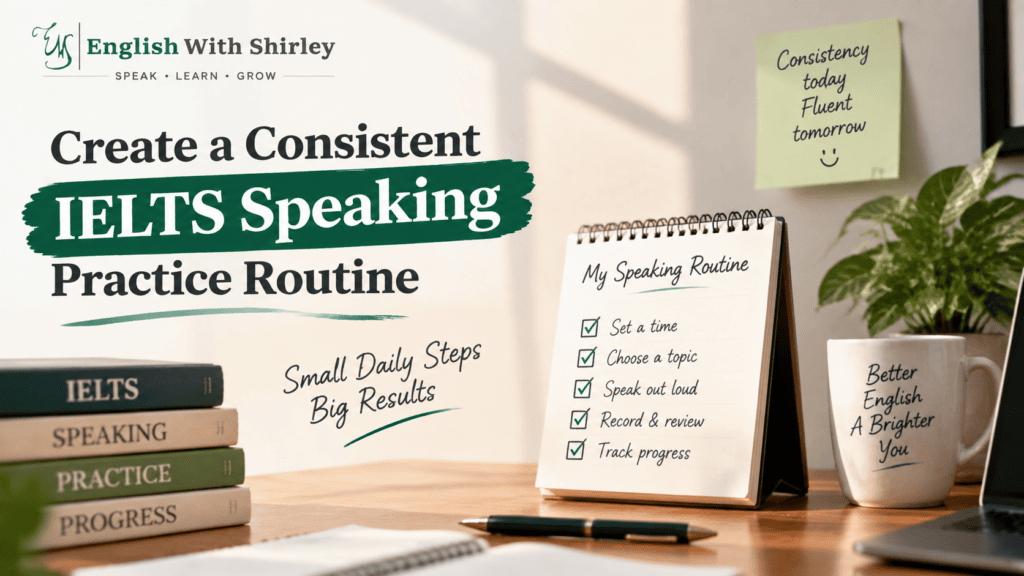
Create a Consistent IELTS Speaking Practice Routine

Regular practice is one of the best ways to improve speaking performance. Instead of spending an hour speaking without a clear goal, record yourself answering an IELTS Part 2 topic for two minutes.

After recording, review your answer and check:

  1. How often did you use filler words?
  2. Did you use different linking expressions?
  3. Did you repeat the same vocabulary?
  4. Were any sentences rushed or unclear?
  5. Did you use a mixture of simple and complex sentences?

Practise different topics such as work, education, technology, travel, hobbies, and your hometown. If you are looking for structured English courses, guided learning can help you practise consistently and receive support where you need it most.

How to Improve Your IELTS Speaking in Four Weeks

A simple four-week practice plan can make your preparation more organised.

  • Week 1: Focus on fluency, pronunciation, and reducing unnecessary pauses.
  • Week 2: Build topic-specific vocabulary and practise useful collocations.
  • Week 3: Practise complex grammar structures and develop longer answers.
  • Week 4: Complete timed speaking practice and review your weakest areas.

For additional support, consistent professional spoken English practice can also help you become more comfortable expressing ideas clearly in English.

Frequently Asked Questions

Is IELTS Speaking Band 7 difficult to achieve?

Band 7 requires consistent performance across fluency, vocabulary, grammar, and pronunciation. With focused practice and useful feedback, learners can gradually improve their performance.

Does my accent affect my IELTS Speaking score?

You do not need a particular accent. The important factor is that your pronunciation is clear and understandable. Work on sounds, word stress, and intonation rather than trying to completely change your natural accent.

How long should I speak in IELTS Speaking Part 2?

You should aim to use the available speaking time effectively. Use the preparation minute to organise your ideas and then develop your answer with explanations and examples rather than stopping after a short response.

Should I memorise IELTS Speaking answers?

Memorising complete answers is generally not a good strategy. Prepare useful vocabulary, ideas, and expressions instead, but adapt them naturally to the question you receive.

Can grammar mistakes prevent me from getting Band 7?

Occasional mistakes do not automatically prevent a Band 7 score. You should demonstrate a range of grammatical structures while maintaining generally good accuracy and clear communication.

Final Thoughts

Improving your IELTS Speaking score requires more than learning difficult vocabulary. You need to develop fluency, coherence, vocabulary, grammar, and pronunciation together. Identify your weakest area, practise it regularly, record your speaking, and review your performance.

With consistent preparation and the right learning support, you can become more confident in expressing your ideas and work towards your target IELTS Speaking score. Explore IELTS preparation at English with Shirley to continue developing your English communication and speaking skills.

ChatGPT Image Sep 12, 2026, 03_35_49 PM

How to Improve English Communication Skills for Career Growth

Strong English communication skills can make a significant difference in your professional life. Whether you are preparing for a job interview, attending meetings, speaking with clients or giving presentations, the ability to communicate clearly and confidently can help you create better career opportunities.

Improving communication is not only about learning difficult vocabulary or memorising grammar rules. It is about developing practical speaking, listening, writing and interpersonal skills that you can use in real-life situations.

Why English Communication Skills Are Important for Career Growth

English is widely used in professional workplaces, especially when communicating with international clients, colleagues and businesses. Good communication skills can help you express your ideas clearly and participate more confidently in professional discussions.

Strong English communication can also help with interviews, presentations, emails, meetings and networking. If you want structured training, professional spoken English classes can help you practise English in workplace-focused situations.

1. Practise Speaking English Every Day

Regular speaking practice is one of the most effective ways to improve English fluency. Try speaking in English for at least 10 to 15 minutes every day. You can talk about your daily routine, work, hobbies, plans or any topic that interests you.

Do not worry about making mistakes. The purpose of regular practice is to become comfortable expressing your thoughts in English.

2. Improve Your Basic English Grammar

Grammar provides the foundation for clear communication. You should understand basic sentence structure, tenses, articles, prepositions, conjunctions and common grammar patterns.

Instead of focusing only on theoretical rules, practise grammar by creating your own sentences and using them in conversations. A structured English grammar course can help strengthen your foundation.

3. Build Your Professional Vocabulary

Vocabulary plays an important role in professional communication. Learn words and phrases that are relevant to your career, workplace and industry.

For example, learn useful expressions for meetings, presentations, interviews, emails, customer conversations and workplace discussions. Using practical vocabulary regularly will make your communication more natural.

4. Improve Your Listening Skills

Good communication involves both speaking and listening. Listening to English conversations, interviews, presentations, podcasts and professional discussions can help you understand different accents, pronunciation patterns and sentence structures.

Try to notice how fluent speakers introduce ideas, explain problems, ask questions and respond to other people.

5. Develop Better English Writing Skills

Career communication is not limited to speaking. Professionals regularly use written English for emails, reports, proposals, presentations and messages.

Learning how to organise your thoughts and write clear, concise sentences can improve your professional communication. You can also work on your English writing skills to become more confident with professional written communication.

6. Learn to Communicate Confidently in Meetings

Meetings are an important part of professional life. You may need to share an opinion, ask a question, explain a project or respond to another person’s suggestion.

Practise useful phrases for agreeing, disagreeing politely, asking for clarification, giving suggestions and explaining your point of view. With regular practice, you can become more confident when speaking during professional meetings.

7. Practise English for Job Interviews

English communication skills can be especially important during job interviews. Candidates need to introduce themselves, explain their experience, answer questions and discuss their professional goals.

Practise common interview questions and prepare short, clear answers. Focus on communicating your ideas naturally rather than memorising every sentence.

8. Improve Your Presentation Skills

Presentations require more than knowing English. You need to organise your thoughts, explain information clearly and maintain confidence while speaking.

Practise introducing your topic, explaining key points, using transitions and summarising your presentation. Recording yourself while practising can help you identify areas for improvement.

9. Get Regular Feedback

It can be difficult to identify your own grammar, pronunciation and communication mistakes. Regular feedback can help you understand what needs improvement.

English speaking classes and structured business and corporate English training can provide opportunities to practise professional conversations and receive guidance.

English Communication Skills You Should Develop

  • Speaking clearly and confidently
  • Using correct grammar
  • Building professional vocabulary
  • Improving pronunciation
  • Listening actively
  • Writing professional emails
  • Participating in meetings
  • Giving presentations
  • Handling interviews confidently
  • Communicating with clients and colleagues

How Beginners Can Improve English Communication

Beginners should start with simple English rather than trying to use complicated words. Learn basic vocabulary, practise everyday sentences and gradually increase the amount of English you speak each day.

Building basic English speaking skills first can make it easier to move towards professional conversations. Learners can also explore spoken English classes for kids and adults based on their learning requirements.

30-Day English Communication Practice Plan

  1. Days 1–7: Practise basic sentences, introductions and everyday vocabulary.
  2. Days 8–14: Focus on grammar, pronunciation and short conversations.
  3. Days 15–21: Practise workplace conversations, interviews and presentations.
  4. Days 22–30: Combine speaking, listening, reading and writing practice.

Common Mistakes to Avoid

  • Being afraid of making mistakes while speaking
  • Translating every sentence from your native language
  • Learning vocabulary without using it
  • Focusing only on grammar
  • Ignoring listening and pronunciation
  • Practising only occasionally

Consistency is more important than perfection. Even a short daily practice session can help you gradually become more comfortable with English.

Can English Communication Skills Help Your Career?

Yes. Better communication can help you present your ideas more effectively, interact with colleagues and clients, participate in professional discussions and approach interviews with greater confidence.

If you are also preparing for international education or professional opportunities, you can consider structured IELTS preparation alongside your communication practice.

Conclusion

Improving English communication skills is a gradual process that requires regular practice. Focus on speaking every day, strengthening your grammar, expanding practical vocabulary, improving listening and writing skills, and practising professional situations.

With consistent learning and the right guidance, you can become more confident in English communication and use those skills to support your long-term career growth.

Frequently Asked Questions

How can I improve my English communication skills?

Practise speaking every day, improve your grammar and vocabulary, listen to English regularly and get feedback on your pronunciation and communication.

Why are English communication skills important for a career?

They can help you communicate with colleagues and clients, perform better in interviews, participate in meetings and present your ideas clearly.

How can beginners improve spoken English?

Beginners should start with basic vocabulary and simple sentences and gradually move towards longer conversations and professional communication.

Is grammar important for spoken English?

Yes. Basic grammar helps you form clear and accurate sentences. However, grammar should be practised together with speaking and listening.

How long does it take to improve English communication?

The time varies from person to person. Consistent daily practice can gradually improve fluency, confidence, vocabulary and overall communication skills.

Best Spoken English & Communication Skills Courses in Delhi: A Complete Guide

Best Spoken English & Communication Skills Courses in Delhi: A Complete Guide

Best Spoken English & Communication Skills Courses in Delhi: A Complete Guide

English has become an essential skill for students, professionals, job seekers, entrepreneurs, and anyone who wants to communicate confidently. Whether you want to improve everyday conversations, prepare for an interview, communicate better at work, or simply speak English without hesitation, choosing the right learning program can make a significant difference.

If you are searching for the best communication skills course in Delhi, professional spoken English classes near me, or an effective English speaking training course, it is important to choose a program that combines grammar, vocabulary, pronunciation, listening, speaking, and practical communication.

A structured learning approach can help you move from basic sentence formation to confident conversations and professional communication.

Why Are Spoken English and Communication Skills Important?

Being able to communicate clearly in English can be valuable in education, employment, business, and everyday life. Good communication is not only about knowing English words. It is also about knowing how to organise your thoughts, form sentences, listen carefully, and express yourself naturally.

A well-designed English communication skills course should help learners develop several important abilities, including:

  • Speaking fluently and confidently
  • Using correct grammar
  • Building useful vocabulary
  • Improving pronunciation
  • Understanding spoken English
  • Forming sentences correctly
  • Communicating professionally
  • Improving written communication
  • Participating in conversations and discussions

Regular practice is particularly important because English speaking is a practical skill. The more opportunities learners get to use English, the more comfortable they can become.

What Should You Look for in the Best English Speaking Course?

What Should You Look for in the Best English Speaking Course?

When looking for the best course for spoken English, do not choose a program only because it promises quick fluency. Instead, look at the learning structure, practical activities, instructor guidance, and areas covered by the course.

1. Practical Speaking Practice

A good spoken English program should give learners opportunities to speak. Conversations, role plays, discussions, presentations, and question-answer activities can make learning more practical.

If you are searching for best classes for spoken English, prioritise a course that encourages you to actively communicate instead of simply memorising grammar rules.

2. Strong Grammar Foundation

Grammar plays an important role in sentence formation. Learners who want to improve their speaking should understand fundamental grammar concepts and learn how to apply them in real conversations.

A dedicated basic English grammar course can help learners understand essential concepts and use them more confidently while speaking and writing.

3. Vocabulary Development

A strong vocabulary gives you more ways to express your thoughts. However, vocabulary learning should focus on useful words, phrases, expressions, and sentences that you can use in everyday and professional situations.

4. Pronunciation and Fluency

Pronunciation affects how clearly your message is understood. Regular practice can help learners become more comfortable with English sounds, words, stress, and natural speaking patterns.

5. Speaking and Writing Skills

Professional communication requires both spoken and written English. If your goal includes emails, presentations, reports, or other professional writing, developing writing skills alongside speaking can be highly useful.

You can explore dedicated English writing skills training to complement your spoken communication.

Spoken English Classes for Beginners

Many learners searching for English speaking classes for beginners feel nervous because they do not know how to start. Beginners may struggle with vocabulary, grammar, sentence formation, pronunciation, or hesitation.

The best approach is to start with simple and practical concepts before progressing to advanced communication.

Basic English speaking classes can focus on:

  • Everyday vocabulary
  • Basic sentence structures
  • Common English expressions
  • Introduction and conversation practice
  • Basic grammar
  • Pronunciation
  • Listening exercises
  • Simple question-and-answer practice

As learners become more comfortable, they can gradually move towards longer conversations, discussions, presentations, and professional communication.

For learners of different age groups, spoken English for kids and adults can provide a structured way to develop communication skills according to learning requirements.

Professional English Speaking Course for Career Growth

Professional English Speaking Course for Career Growth

English communication becomes particularly important in professional environments. Employees and job seekers may need English for interviews, meetings, presentations, client communication, emails, networking, and workplace conversations.

A professional English speaking course should therefore go beyond everyday conversations and help learners communicate effectively in professional situations.

Important areas can include:

  • Professional introductions
  • Interview communication
  • Workplace conversations
  • Business vocabulary
  • Presentations
  • Meetings
  • Client communication
  • Professional emails
  • Confidence-building exercises

If your primary goal is workplace communication, you can explore spoken English for professionals for focused professional English development.

Professional English Speaking and Writing Course

Professional communication is not limited to speaking. Employees often need to write emails, reports, messages, proposals, presentations, and other business documents.

A professional English speaking and writing course can therefore help learners develop both verbal and written communication skills.

Combining speaking and writing practice can help you become more confident when communicating with colleagues, managers, customers, and business partners.

Business and Corporate English Communication

Businesses often require employees to communicate clearly with customers, colleagues, international clients, and partners. Corporate communication may involve formal conversations, presentations, meetings, negotiations, emails, and professional discussions.

If you are a working professional or organisation looking for structured corporate communication training, explore business and corporate English training.

Developing professional communication skills can help employees communicate their ideas more clearly and participate more confidently in workplace situations.

Best English Classes Near Me: How to Choose the Right Course

Best English Classes Near Me: How to Choose the Right Course

People searching for best English classes near me often compare different courses based on location, learning format, course structure, and objectives.

Before enrolling, consider what you actually want to achieve.

  • For beginners: Choose a course that focuses on basic grammar, vocabulary, pronunciation, and everyday speaking.
  • For professionals: Look for professional speaking, business communication, presentations, and workplace English.
  • For students: Focus on grammar, vocabulary, writing, speaking, and confidence.
  • For IELTS aspirants: Choose structured IELTS preparation with all relevant language skills.
  • For flexible learners: Consider online spoken English learning options.

You can explore the complete range of English courses to identify a program that matches your learning objectives.

Spoken English Course in Delhi for Better Fluency

Delhi has learners from diverse educational and professional backgrounds, and many people search for spoken English course in Delhi to improve their confidence and communication.

However, fluency does not develop simply by attending classes. A good course should combine structured lessons with consistent speaking practice.

A comprehensive spoken English language course may include:

  • Speaking practice
  • Grammar
  • Vocabulary
  • Pronunciation
  • Listening
  • Reading
  • Writing
  • Conversation practice

This balanced approach allows learners to improve multiple aspects of English rather than concentrating on only one skill.

Online Spoken English Classes

Online education has made English learning more flexible. Learners who cannot attend physical classes regularly can consider spoken English classes online near me or other online English learning options.

When choosing the best English communication course online, look for an interactive learning experience. Simply watching recorded lessons may not provide enough speaking practice.

An effective online program should ideally include:

  • Interactive lessons
  • Speaking activities
  • Real-time feedback
  • Conversation practice
  • Grammar exercises
  • Pronunciation practice
  • Assignments and activities

Online learning can be particularly useful for people with busy schedules who want to learn English speaking online without travelling to a physical classroom.

Best English Grammar Classes Online

Grammar is one of the foundations of effective communication. Learners who frequently make mistakes while speaking may benefit from strengthening their grammar fundamentals.

Basic English grammar classes can introduce concepts such as:

  • Nouns and pronouns
  • Verbs
  • Adjectives and adverbs
  • Articles
  • Prepositions
  • Tenses
  • Modals
  • Sentence structures
  • Questions
  • Reported speech

The goal should not be to memorise grammar rules without context. Instead, learners should understand how grammar works and practise using it in real sentences and conversations.

If flexibility is important to you, best English grammar classes online can allow you to learn and practise from your preferred location.

How to Improve English Speaking Skills Every Day

Joining the best course to speak English fluently can provide structured guidance, but regular practice outside the classroom is equally important.

Speak English Daily

Spend at least a few minutes speaking English every day. Talk about your daily routine, work, studies, interests, plans, or experiences.

Think in English

Try to form simple thoughts directly in English instead of translating every sentence from another language.

Read English Content

Reading articles, books, stories, and educational content can help you learn sentence structures and expand your vocabulary.

Listen to English

Listen to interviews, conversations, podcasts, educational videos, and other English content. This can help improve listening comprehension and expose you to natural pronunciation.

Practise New Vocabulary

Whenever you learn a new word, create a few sentences with it. This makes it easier to remember and use the word naturally.

Do Not Be Afraid of Mistakes

Mistakes are part of the learning process. Instead of waiting until your English is perfect, focus on communicating regularly and improving gradually.

Best Course to Learn English Speaking: What Makes a Difference?

Best Course to Learn English Speaking: What Makes a Difference?

The best course to learn English speaking is not necessarily the course with the most complicated syllabus. It is the one that matches your current level, goals, learning style, and practice requirements.

A good spoken English learning course should provide a clear progression from fundamentals to practical communication.

For beginners, this may mean starting with grammar and vocabulary. Intermediate learners may need more conversation and fluency practice, while professionals may need business communication and presentation skills.

You can review the available English language courses to find an option that fits your specific learning requirements.

English Communication Skills for Students and Professionals

Communication skills are useful across different stages of life. Students may need English for academic work, presentations, interviews, and higher education. Professionals may require English for meetings, emails, client conversations, presentations, and career growth.

This is why best courses to improve communication skills generally combine speaking, listening, reading, writing, vocabulary, grammar, and confidence-building activities.

Improving these skills together can help learners become more comfortable in both casual and professional situations.

IELTS and English Proficiency Preparation

Some learners want to improve their English because they are preparing for an international examination or planning to study or work abroad.

If your objective is IELTS preparation, you can explore the dedicated IELTS course available on English With Shirley.

IELTS preparation can also support broader English development by encouraging learners to work on reading, writing, listening, speaking, vocabulary, grammar, and communication.

Why Choose a Structured English Learning Program?

Self-learning can be useful, but many learners struggle with consistency, pronunciation, grammar mistakes, and lack of speaking practice.

A structured course can provide a learning roadmap and regular opportunities to practise English.

When comparing the best English language institute in Delhi or searching for the best English language course, consider factors such as:

  • Course curriculum
  • Instructor guidance
  • Speaking opportunities
  • Grammar coverage
  • Vocabulary development
  • Pronunciation practice
  • Writing support
  • Learning format
  • Course suitability for your level

You can also learn more about the approach and learning experience by visiting Why Choose Us.

Frequently Asked Questions

What is the best course to learn English speaking?

The best course depends on your current English level and objective. Beginners should choose a course covering basic grammar, vocabulary, pronunciation, and speaking practice, while professionals may benefit from business and professional English training.

Which is the best course for spoken English?

A good spoken English course should combine speaking practice with grammar, vocabulary, pronunciation, listening, and real-life communication activities.

Are online spoken English classes effective?

Online classes can be effective when they provide interactive lessons, regular speaking opportunities, instructor feedback, and practical exercises.

Can beginners join English speaking classes?

Yes. Beginners can start with basic vocabulary, sentence formation, grammar, pronunciation, and simple conversations before progressing towards advanced communication.

How can I improve my English speaking skills?

Practise speaking every day, listen to English regularly, learn useful vocabulary, strengthen your grammar foundation, read English content, and participate in conversations.

Should I learn grammar before speaking English?

You do not need to master all grammar before speaking. It is generally more useful to learn basic grammar while practising speaking so that you can gradually improve both accuracy and fluency.

Start Improving Your English Communication Skills

info@serptriumph.com

Whether you are a beginner, student, job seeker, or working professional, improving your English can help you communicate with greater confidence.

The right English communication skills online course or classroom program should focus on practical learning rather than memorisation alone. Speaking, grammar, vocabulary, pronunciation, listening, reading, and writing all contribute to effective communication.

If you are looking for the best communication skills course in Delhi, professional spoken English classes near me, best English classes near me, or a professional English speaking course, explore the available programs and choose one that matches your goals.

With structured guidance, consistent practice, and regular opportunities to communicate, you can gradually develop stronger English speaking skills and greater confidence.

Contact English With Shirley to learn more about the available English learning programs and find the right option for your requirements.